The Shooting of the SD Men
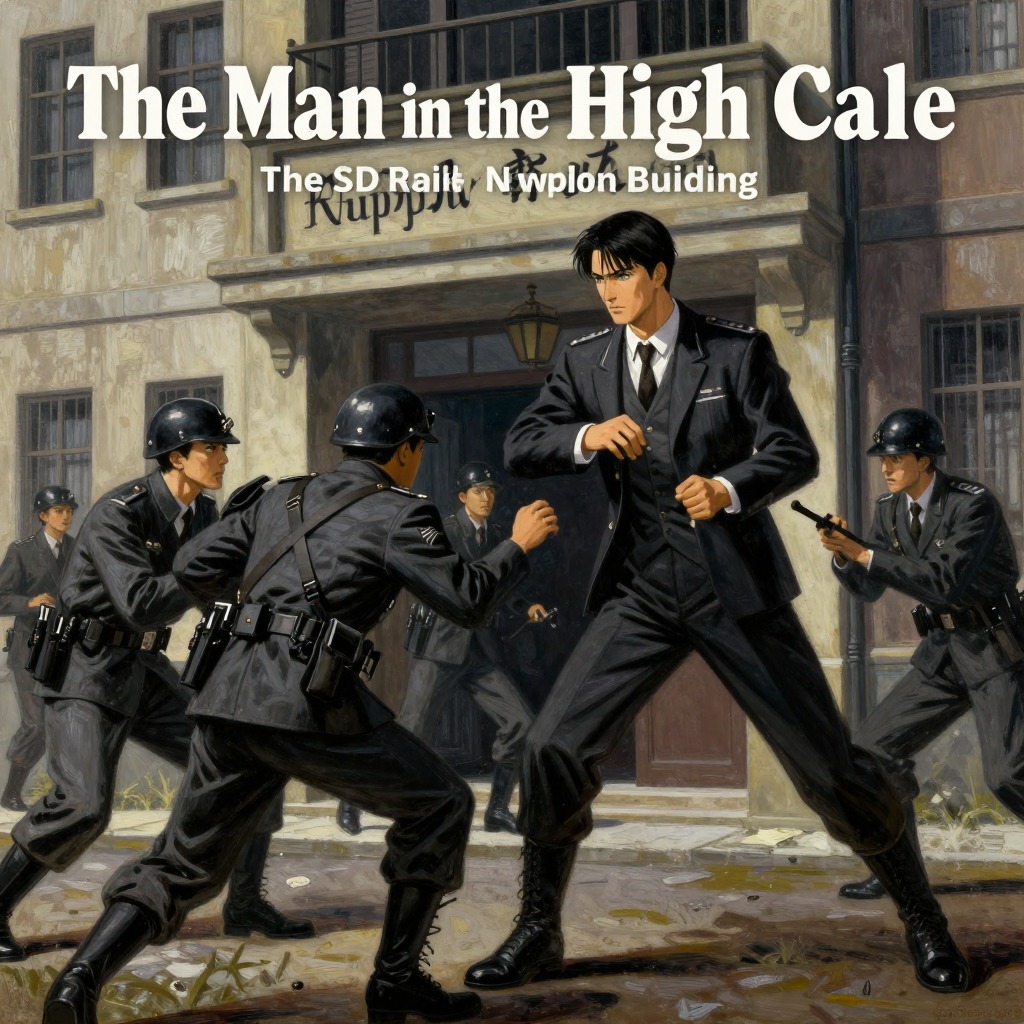
The Shooting of the SD Men is the novel's central eruption of physical violence, a sudden, brutal rupture in the otherwise bureaucratic and ceremonial world of the Pacific States of America. It occurs in the twentieth-floor office of Nobusuke Tagomi in the Nippon Times Building, where the ranking Trade Mission official has been hosting a secret meeting between Rudolf Wegener, the Abwehr captain traveling under the cover name Mr. Baynes, and General Tedeki, the retired Imperial Chief of Staff posing as the elderly businessman Shinjiro Yatabe. The three men have just concluded the most sensitive part of their discussion—Wegener's revelation of Operation Dandelion, the planned German nuclear attack on the Home Islands—when the SD, the German security police, attempts to seize Wegener by force. The event is the novel's most direct dramatization of the Nazi threat, and it permanently alters the course of Tagomi's life, driving him into a psychological and spiritual crisis from which he never fully recovers.
The Confrontation in the Office
The attack comes without warning. Two burly white men, both armed with pistols equipped with silencers, burst through the office door and immediately identify Wegener, shouting "Da ist er" as they move toward him. Tagomi, who has been sitting at his desk with a loaded Colt .44 revolver from his personal collection, reacts with astonishing speed. He points the antique single-action weapon at the intruders and compresses the trigger, dropping the first SD man to the floor. The second man whips his silenced gun toward Tagomi and returns fire; Tagomi hears no report, only sees a tiny wisp of smoke and hears the whistle of a slug passing near. With what the narrative describes as record-eclipsing speed, he fans the hammer of the single-action Colt, firing it again and again. The second SD man's jaw bursts—bits of bone, flesh, and shreds of tooth fly into the air. Hit in the mouth, the man's eyes still contain life for a moment; he still perceives Tagomi, and then the eyes lose their luster and he collapses, dropping his gun and making unhuman gargling noises. Tagomi's only comment is a single word: "Sickening."
The shooting is over in seconds. No more SD men appear in the open doorway. Tagomi, engaged in the tedious three-minute task of reloading his antique revolver, presses the intercom button to summon medical emergency aid for the hideously injured thug, but receives no answer, only a hum. Wegener, stooping, picks up both of the Germans' guns and passes one to General Tedeki, keeping the other for himself. Tagomi, reseating himself with his Colt as before, declares, "Now we will mow them down. Formidable triumvirate, in this office." From the hall, a voice calls out that the German hoodlums have surrendered; Tagomi replies that they are already taken care of, lying either dead or dying, and invites the speakers to advance and verify empirically. A party of Nippon Times employees gingerly appears, several carrying building riot equipment—axes, rifles, and tear-gas grenades.
The Aftermath and the Revelation of the Attackers
In the immediate aftermath, the three men assess what has just happened. Tagomi, still shaky, declares the event a cause célèbre, noting that the PSA Government in Sacramento could declare war on the Reich without hesitation. But Wegener, more experienced in the ways of the SD, corrects him. "They will deny complicity," he says. "Standard technique. Used countless times." He lays the silenced pistol on Tagomi's desk and points out that it is made in Japan—excellent quality Japanese target pistol, in fact. Wegener has also taken the wallet of the dead man and discovered that he is not a German national at all, but a PSA citizen named Jack Sanders who lives in San Jose, with nothing to connect him to the SD. Tagomi immediately grasps the implication: the attack will be officially described as a holdup, with the motive being the office's locked vault, and no political aspects. The assassination or kidnapping attempt by the SD has failed, at least this first one, but clearly they know who Wegener is and what he has come for. Tagomi's prognosis is gloomy.
Tagomi's Moral and Psychological Crisis
The shooting plunges Tagomi into a profound crisis that the narrative explores in detail. Wegener, watching Tagomi distractedly manipulate the forty-nine yarrow stalks of the I Ching, recognizes how deep the man's distress is. For Tagomi, the event—his having had to kill and mutilate these two men—is not only dreadful but inexplicable. General Tedeki, standing beside Wegener, offers a quiet diagnosis: "You witness the man's despair. He, you see, was no doubt raised as a Buddhist. Even if not formally, the influence was there. A culture in which no life is to be taken; all lives holy." Wegener nods, understanding that Tagomi will recover his equilibrium in time, but that right now he has no standpoint by which he can view and comprehend his act. Wegener reflects that another frame of reference which might help Tagomi would be the Doctrine of Original Sin—the idea that all are doomed to commit acts of cruelty or violence or evil, that it is their destiny due to ancient factors, their karma. To save one life, Tagomi has had to take two; the logical, balanced mind cannot make sense of that. A kindly man like Tagomi could be driven insane by the implications of such reality.
Wegener's own reflection on the event reveals the novel's central moral dilemma. He thinks that the crucial point lies not in the present, not in either his death or the death of the two SD men, but hypothetically in the future. What has happened here is justified, or not justified, by what happens later—can they perhaps save the lives of millions, all Japan in fact? But the man manipulating the vegetable stalks cannot think of that; the present, the actuality, is too tangible, the dead and dying Germans on the floor of his office. General Tedeki is right that time will give Tagomi perspective, but Wegener also recognizes that he and the general are not really different from Tagomi; they are faced with the same confusions. They can only wait, hoping that finally he will recover and not succumb.
The Aftermath: Tagomi's Descent and the Silver Triangle
The shooting sets in motion Tagomi's gradual breakdown, which culminates in his heart attack later in the novel. In the days following the event, he cannot return to his normal routine. He wanders the city, riding the cable car to the end of the line and back, unable to find peace. He carries the Colt .44 with him constantly in his briefcase, keeping it within easy reach in case vengeful hooligans of the SD should try to repay him as an individual. He recognizes this as neurotic—a compulsion-obsession-phobia—but he cannot free himself. "It in my grip, I in its," he thinks. He attempts to trade the gun in at Robert Childan's store, hoping to free himself from the cloud of the past, but Childan refuses to accept it, and Tagomi is forced to keep the weapon that has become saturated with subjective history of the wrong kind.
It is in this state that Tagomi encounters the Edfrank silver triangle, the piece of contemporary American jewelry that Robert Childan has begun to champion. Childan shows it to Tagomi as "the new life of my country," but Tagomi initially dismisses it as scraps. Yet, in his desperation, he returns to the store and buys one, carrying it about with him and examining it at regular intervals, hoping to find in it some meaning that will restore his equilibrium. Sitting in Portsmouth Square, he subjects the small silver triangle to an intense, almost ritualistic scrutiny—shaking it, holding it to his ear, tasting it, and finally gazing into it as it reflects the midday sun. In this moment of concentration, he experiences a vision of the object as a microcosm, a unification of yin and yang, of the dark earth and the brilliant light of the sky. He feels himself on the verge of a profound spiritual insight, a release from the cycle of birth and death, when a policeman interrupts him, asking if he is working a child's puzzle. The moment is shattered, and Tagomi is left feeling that his chance at nirvana has been spoiled by a white barbarian Neanderthal yank.
The vision leaves Tagomi disoriented and lost. He wanders the streets in a state of acute perceptual distortion, seeing the Embarcadero Freeway as a hideous misshapen thing on the skyline, entering a lunch counter where no white man will yield him a stool, and feeling as though he has broken from his moorings and stands on nothing. He realizes he has left the silver triangle on the bench in the park and runs back to retrieve it, finding it fallen through to the grass where he had hurled it in rage. He recovers it and, with the help of two Chinese boys who confirm that pedecabs are available, returns to the Nippon Times Building. There he confronts the German consul, Hugo Reiss, who has come to smooth over the incident. Tagomi, in a state of barely controlled anguish, tells Reiss that he personally shot the two SD men, that guilt is on his soul, and that blood can never be eradicated like ink. He delivers a prophetic warning that the Reich is about to descend into greater vileness than ever, and then, in a final act of defiance, refuses to sign the Form 20-50 requesting the remand of Frank Frink, the Jewish prisoner, to German custody, scribbling "Release" on the form instead. Immediately after this confrontation, Tagomi suffers a heart attack, collapsing in his office as he clutches the silver triangle that did not save him. The shooting of the SD men thus becomes the catalyst for Tagomi's physical and spiritual collapse, the moment that exposes the unbearable moral weight of living under and serving a system that demands such violence.